Madagascar’s military has announced that it has taken control of the government following the impeachment of President Andry Rajoelina by parliament after weeks of mass, youth-led anti-government protests.
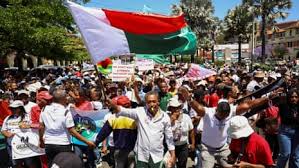
The declaration came from Colonel Michael Randrianirina, who said the armed forces were assuming authority to “restore order” after Rajoelina fled the country. The announcement was met with celebrations in the streets of Antananarivo, the capital, as cheering crowds welcomed the military’s intervention.
“We have taken power,” Randrianirina declared, adding that the military had suspended all state institutions except the lower house of parliament.
Colonel Randrianirina later told reporters that a military-led committee would oversee the country alongside a transitional government for up to two years, during which time a new constitution would be drafted and elections held.
“The renovation period will last a maximum of two years. During this time, we will hold a referendum to establish a new constitution, followed by general elections to rebuild democratic institutions,” he explained.
A statement from the military confirmed the suspension of several key institutions, including:
- The Senate
- The High Constitutional Court
- The Independent National Electoral Commission
- The High Court of Justice
- The High Council for the Defense of Human Rights and the Rule of Law
Earlier in the day, President Rajoelina — whose location remains unknown — had attempted to dissolve the lower house by decree in a last-ditch effort to cling to power. However, lawmakers went ahead with the impeachment vote, triggering a constitutional standoff that paved the way for the military’s takeover.
Rajoelina denounced the move as “a clear act of attempted coup d’état.”
In a statement, the presidency insisted that Rajoelina “remains fully in office and continues to safeguard constitutional order and national stability.”
Reporting from the army headquarters, Al Jazeera’s Fahmida Miller said large crowds in Antananarivo celebrated the announcement with cheers and applause.
The power shift follows weeks of protests, spearheaded by Gen Z Madagascar, a youth-driven movement that began on September 25 over water and electricity shortages. The demonstrations quickly evolved into broader demands for Rajoelina’s resignation amid rising poverty, inflation, and corruption allegations.
A turning point came when an elite military unit, the CAPSAT, defected from Rajoelina’s control and sided with protesters. The same unit had played a pivotal role in the 2009 coup that originally brought Rajoelina to power.
On Tuesday, local outlet 2424.mg reported that police and gendarmerie forces had also joined the demonstrations, further isolating the president.
Rajoelina later claimed on social media that he had left the country “in fear for his life” and was in a “safe space.” Sources told Reuters he departed Madagascar aboard a French military aircraft, though French President Emmanuel Macron has not confirmed any involvement.
The United Nations reported that at least 22 people have been killed and more than 100 injured since the protests began, though the government has disputed those numbers.
Rajoelina, a former mayor of Antananarivo who branded himself as a reformist, had previously led a transitional government between 2009 and 2014 before returning to win elections in 2019 and again in 2023.
However, years of economic hardship, erratic power supply, and widespread corruption have deepened public anger in one of the world’s poorest nations, where only a third of citizens have access to electricity and blackouts can last over eight hours daily.
The Gen Z Madagascar movement has drawn inspiration from similar youth-led uprisings in Kenya, Indonesia, and Peru, which have successfully challenged entrenched governments.
With the military now in charge and key institutions suspended, Madagascar faces an uncertain future as it heads into another turbulent transition.