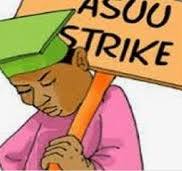
Nigeria’s Academic Staff Union of Universities (ASUU) has announced plans to begin a two-week nationwide strike starting Monday, October 13, 2025, following the expiration of a two-week ultimatum issued to the Federal Government over unresolved issues in the university system.
ASUU President, Professor Chris Piwuna, confirmed the industrial action during a press briefing held at the University of Abuja on Sunday.
“It is regrettable to note that nothing significant has happened to change the position of NEC since we last briefed the press. Consequently, all branches of ASUU are hereby directed to withdraw their services with effect from midnight on Monday, 13 October 2025,” Piwuna said.
He explained that the two-week warning strike would be total and comprehensive, as the government had failed to address the union’s key demands despite repeated negotiations and deadlines.
⚠️ Background: Unresolved Issues Despite Repeated Ultimatums
Two weeks earlier, ASUU’s National Executive Council (NEC) and its various chapters voted overwhelmingly in favor of a strike after issuing a final ultimatum to the government.
Midway into the ultimatum, ASUU accused the government of failing to take meaningful steps to avert industrial action.
This marks ASUU’s first nationwide strike since 2022, and the first under President Bola Ahmed Tinubu’s administration. In 2022, the union embarked on an eight-month strike—from February to October—before being ordered to resume work by an industrial court following a suit filed by then-Labour Minister Chris Ngige.
In an effort to prevent another strike, Minister of Education, Dr. Tunji Alausa, had in August 2025 set up a committee led by Permanent Secretary Abel Enitan to review the draft agreement between ASUU and the Yayale Ahmed-led committee.
That committee submitted its report in February 2025, but no tangible progress was made.
On Tuesday, the Federal Government reconstituted a new body—the Federal Government Tertiary Institutions Expanded Negotiation Committee, again chaired by Yayale Ahmed, to resume discussions with ASUU and other unions.
However, ASUU said an “emergency meeting” held with the committee on Friday, October 10, 2025, yielded no positive outcome.
“The presentation to our team was a total departure from the letter and spirit of the ‘Review of the Draft 2022 Agreement’ submitted by the Yayale Ahmed Committee. To say the least, the documents were neither here nor there,” Piwuna said.
The current committee is the sixth set up by the government since the initial 2009 ASUU-Federal Government Agreement, which has remained at the heart of the dispute.
Successive committees—chaired by Wale Babalakin (2017–2020), Munzali Jibrin (2021), Nimi Briggs (2022), and Yayale Ahmed (2024–2025)—have all failed to produce a lasting resolution as the government has repeatedly refused to sign or implement their recommendations.
According to ASUU, the ongoing dispute revolves around:
- Full implementation of the renegotiated 2009 FGN–ASUU Agreement
- Release of withheld 3½ months’ salaries
- Adequate and sustainable funding for public universities
- Revitalization of tertiary institutions
- Payment of 25–35% outstanding salary arrears
- Payment of promotion arrears for over four years
- Release of withheld cooperative deduction funds
The 2009 agreement—last reviewed over a decade ago—covers academics’ conditions of service, salary structure, university funding, and institutional autonomy.
ASUU accuses the government of failing to honor its commitment to invest ₦1.2 trillion in university revitalization between 2009 and 2015, of which only ₦200 billion has reportedly been released.
The union also continues to oppose the use of the Integrated Personnel Payroll Information System (IPPIS), which it argues undermines university autonomy.
ASUU insists that the strike is a warning action meant to compel the government to act in good faith before a total shutdown of the university system.
“There is nothing sufficient to stop the implementation of the NEC resolution. This warning strike is to remind the government of its unfulfilled promises and to demand fairness for Nigerian academics,” Piwuna emphasized.
The union called on the Tinubu administration to prioritize education reform and demonstrate genuine commitment to resolving long-standing issues that have crippled the nation’s tertiary institutions for more than a decade.