France has been thrown into fresh political uncertainty as Prime Minister Sébastien Lecornu resigned less than a month after taking office, citing an inability to build consensus among deeply divided political factions.
“The conditions were not fulfilled for me to carry on as prime minister,” Lecornu said in a statement on Monday, lamenting the “partisan appetites” and lack of compromise among lawmakers.
The resignation was confirmed by the Elysée Palace shortly after Lecornu’s one-hour meeting with President Emmanuel Macron, marking yet another setback for the embattled French leader, whose government has struggled to maintain stability amid growing political fragmentation.
Lecornu’s departure comes just 26 days after his appointment, following the collapse of François Bayrou’s administration. His cabinet, unveiled less than 24 hours before his resignation, drew sharp criticism across the political spectrum for retaining most ministers from the previous government.
Lawmakers from both the left and right blocs immediately vowed to vote down the new cabinet, accusing Macron of recycling failed leadership and ignoring voters’ demand for change.
The sudden resignation has reignited calls for early parliamentary elections. Opposition leader Marine Le Pen of the National Rally (RN) said the only “honourable solution” was to return to the polls.
“The joke’s gone on long enough,” Le Pen declared. “French people are exhausted. President Macron has plunged the country into a dangerous political deadlock.”
Other opposition figures echoed her demand, while some went further, urging Macron himself to resign—a step the president has repeatedly ruled out before his term ends in 2027.
Analysts say Macron now faces three unenviable options: appoint another prime minister, dissolve the National Assembly and call new elections, or resign himself—the latter seen as highly improbable.
With Lecornu’s departure, Macron loses one of his most trusted allies. A loyal technocrat and former armed forces minister, Lecornu was viewed as Macron’s last safe choice to steady the government. His failure underscores how ungovernable the current National Assembly has become.
Appointing a Socialist prime minister could appease the left but would likely lead to another short-lived government. Political observers suggest that fresh elections may be Macron’s only path forward, though they could hand a sweeping victory to Le Pen’s far-right National Rally.
Political Gridlock and Economic Pressures
France’s political paralysis dates back to July 2024, when Macron’s snap parliamentary elections—intended to secure a working majority—backfired spectacularly. The result was a hung parliament, with centrist, leftist, and far-right factions unwilling to cooperate.
Since then, three governments have fallen in quick succession:
- Michel Barnier’s administration lasted three months.
- François Bayrou’s government was toppled after nine months.
- Now Lecornu’s tenure has ended in less than four weeks.
Meanwhile, France’s economic challenges are mounting. The budget deficit reached 5.8% of GDP in 2024, while national debt stands at 114% of GDP — among the highest in the eurozone, after Greece and Italy.
Lecornu’s resignation triggered an immediate reaction in financial markets, with Paris stocks sliding sharply on Monday morning amid investor concerns over prolonged political instability.
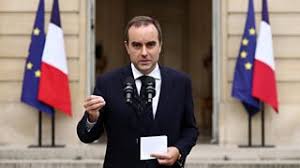
In his farewell remarks outside the Hôtel de Matignon, Lecornu expressed frustration at France’s political stalemate.
“I was ready for compromise,” he said, “but all parties wanted the others to adopt their programmes in full. It wouldn’t take much for this to work—only humility and a willingness to cast some egos aside.”
As Macron deliberates his next move, France finds itself once again at a crossroads — facing not only a crisis of governance but also a test of democratic endurance in a deeply polarised society.