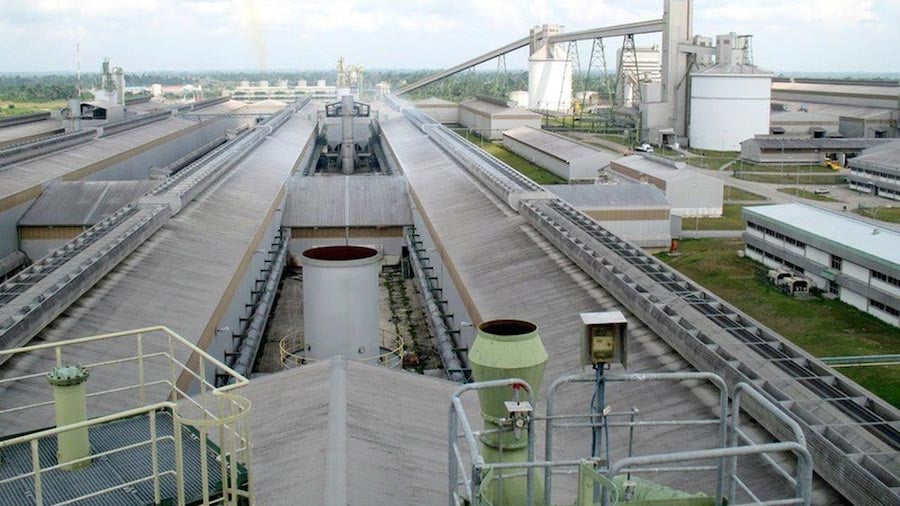
The Federal Government has announced plans to generate 540 megawatts (MW) of electricity from the revived Aluminium Smelting Company of Nigeria (ALSCON) in Ikot Abasi, Akwa Ibom State, as part of its broader effort to strengthen the national grid and expand industrial power generation.
The Minister of Power, Adebayo Adelabu, disclosed this on Monday during an inspection visit to the ALSCON facility. He reaffirmed the government’s commitment to reconnecting the plant to the national grid and completing the long-abandoned 330 kV substation in the area.
Adelabu described the plant as a strategic industrial asset, lamenting that nearly four decades after its establishment, ALSCON had not contributed meaningfully to Nigeria’s economy due to inadequate electricity supply.
According to a statement issued by his media aide, Bolaji Tunji, the minister explained that ALSCON was conceived in 1989 and completed in 1998, but failed to achieve full operation after the 2006 privatisation, when it was taken over by the Aluminium Smelting Company of Russia.
“These huge national investments have suffered due to lack of power for the last 27 years. We recognise the enormous potential of this company across the aluminium value chain — from upstream to downstream — in creating jobs, supplying raw materials, and saving foreign exchange,” Adelabu said.
He added that the Federal Government is determined to accelerate electricity access for Nigerians in line with Vision 2030 and the Tanzania Declaration on Energy Expansion.
Adelabu further revealed that the Transmission Company of Nigeria (TCN) and the Niger Delta Power Holding Company (NDPHC) have developed short- and medium-term plans to reconnect ALSCON to the grid.
“We’ve made significant progress. The short-term solution to connect this company to the grid has been defined, and the medium-term framework has also been agreed upon. Importantly, ALSCON has the capacity to supply 540 MW of power when fully operational,” he noted.
The minister explained that the plant’s installed capacity comprises six turbines of 90 MW each, all of which remain in good condition. Once the 330/132 kV substation and transmission lines between Ikot Ekpene and Ikot Abasi are completed, the full capacity can be transmitted to the grid.
Adelabu added that there is potential to expand output by another 120 MW, bringing total capacity to 660 MW, through circuit upgrades and turbine optimisation.
He assured that the Ministry of Power would personally oversee the substation completion and reconnection process, noting that Nigerians would begin to feel the impact within 90 days of implementing short-term fixes.
“ALSCON’s revival will not only strengthen Nigeria’s power supply but also stimulate industrialisation, create up to 15,000 direct and indirect jobs, and reduce foreign exchange losses from aluminium imports,” he said.
On the issue of gas supply, Adelabu stated that it could be resolved through “appropriate pricing mechanisms” to ensure steady fuel supply to the turbines.
Meanwhile, ALSCON’s Development Adviser, Viacheslav Krylov, revealed that the company plans to ramp up production to 200,000 metric tonnes within six years once power stability is achieved.
He emphasised that a reliable grid connection and power purchase agreements (PPAs) would be crucial for sustainable operations.
“The current energy options are inadequate to restart the plant. We appeal for a dedicated backup power source and improved grid stability to ensure long-term production,” Krylov said.
The revival of ALSCON marks a significant step toward Nigeria’s industrial power expansion, promising both energy diversification and economic revitalisation for the nation’s manufacturing sector.