The Federal Government of Nigeria has enacted a 5% surcharge on fossil fuel products, including petrol, diesel, and aviation fuel, under the recently signed Nigeria Tax Administration Act—a key component of President Bola Tinubu’s sweeping tax reform package. The tax will be applied at the point of sale, supply, or payment, encompassing both locally produced and imported fuels.
Based on 2024 fuel consumption data (18.75 billion litres of petrol at an average price of ₦850 per litre), the surcharge could generate as much as ₦796 billion annually from petrol alone. Including diesel, aviation fuel, and other fossil fuels, total revenue could significantly exceed this estimate.
PUBLIC REACTION
Peter Obi (opposition leader) criticized the decision, noting that Nigerians remain burdened from previous economic shocks. He urged postponement until citizens see concrete improvements.
The ADC political party condemned the tax as cruel and misguided, accusing the government of ignoring public welfare despite revenue claims and borrowing.
Economic experts like Dr. Muda Yusuf (CPPE) warned implementation without safeguards could fuel inflation and public distrust.
The Arewa Youths Assembly urged that citizens should not bear the cost of the country’s energy transition.
ANRPM supported the concept only if accompanied by immediate, visible road repairs.
THE BIGGER PICTURE: TAX REFORM IN NIGERIA
The Harmonized Tax Act is part of President Tinubu’s fiscal modernization strategy aimed at:
- Broadening the tax base beyond oil exports.
- Unifying fragmented tax laws for easier compliance.
- Increasing non-oil revenue to reduce budget deficits.
- Aligning with global climate transition policies, by discouraging heavy fossil fuel use.
- Nigeria currently has one of the lowest tax-to-GDP ratios in Africa (\~10%), compared to the African average of 15–17%. This reform, including the fuel surcharge, is designed to close that gap.
Sectoral Impacts of the 5% Fuel Tax
1. Transport Sector
Impact: Public transport operators will pass on costs, raising fares for buses, taxis, and ride-hailing. Air travel costs will rise due to aviation fuel being taxed.
Advantage: If revenue is indeed reinvested in better roads, rail, and bus systems, long-term logistics costs could drop.
Disadvantage: Short-term, commuters will face inflationary shocks.
2. Agriculture & Food Prices
Impact: Farmers rely heavily on diesel for irrigation pumps, tractors, and transporting crops to markets. Costs will rise along the supply chain.
Advantage: Improved rural roads from tax revenue could reduce post-harvest losses.
How will Nigeria’s 5% fuel tax affect citizens?
Advantages and disadvantages of Nigeria’s fuel tax
Impact of 5% fuel levy on transport and food prices
Food prices will likely spike before infrastructure gains are felt, worsening food inflation.
3. Small & Medium Enterprises (SMEs)
Impact: Many SMEs depend on petrol or diesel generators due to unreliable power supply. The tax raises their operational costs.
Advantage: If government expands electricity access using renewable incentives (LPG, CNG, solar), SMEs may gradually benefit.
Disadvantage: In the near term, businesses face higher production costs, reducing competitiveness.
4. Energy & Green Transition
Impact: Tax exemptions for LPG, CNG, and renewables make them more attractive alternatives.
Advantage: Pushes Nigeria closer to net-zero goals and aligns with international climate financing opportunities.
Disadvantage: Transition costs are high, and Nigerians may not easily switch without subsidies and infrastructure.
5. Households & Poverty Levels
Impact: Ordinary Nigerians, especially low-income earners, will spend more on fuel and transportation.
Advantage: If targeted social protection programs are linked to the revenue, the poor may benefit indirectly.
Disadvantage: Without safeguards, this tax is regressive, hitting the poor hardest.
KEY RISKS & SAFEGUARDS NEEDED
✔ Transparency – Independent oversight of revenue collection and spending.
✔ Phased Implementation – Gradual rollout with palliative measures.
✔ Targeted Social Programs – Subsidies for transport, agriculture, or renewable adoption.
✔ Stakeholder Engagement – Consult unions, farmers, SMEs, and opposition parties to build trust.
✔ Digital Tax Tracking – Use of technology to prevent leakages and corruption.
CONCLUSION
The 5% fuel tax could be a bold step toward fiscal sustainability, greener energy, and better infrastructure. But without transparency, social safety nets, and careful rollout, it risks worsening inflation and eroding public trust.
The measure is therefore a balancing act:
LONG-TERM EFFECT: Economic stability and modernization,
SHORT-TERM: Economic pain for citizens and businesses.
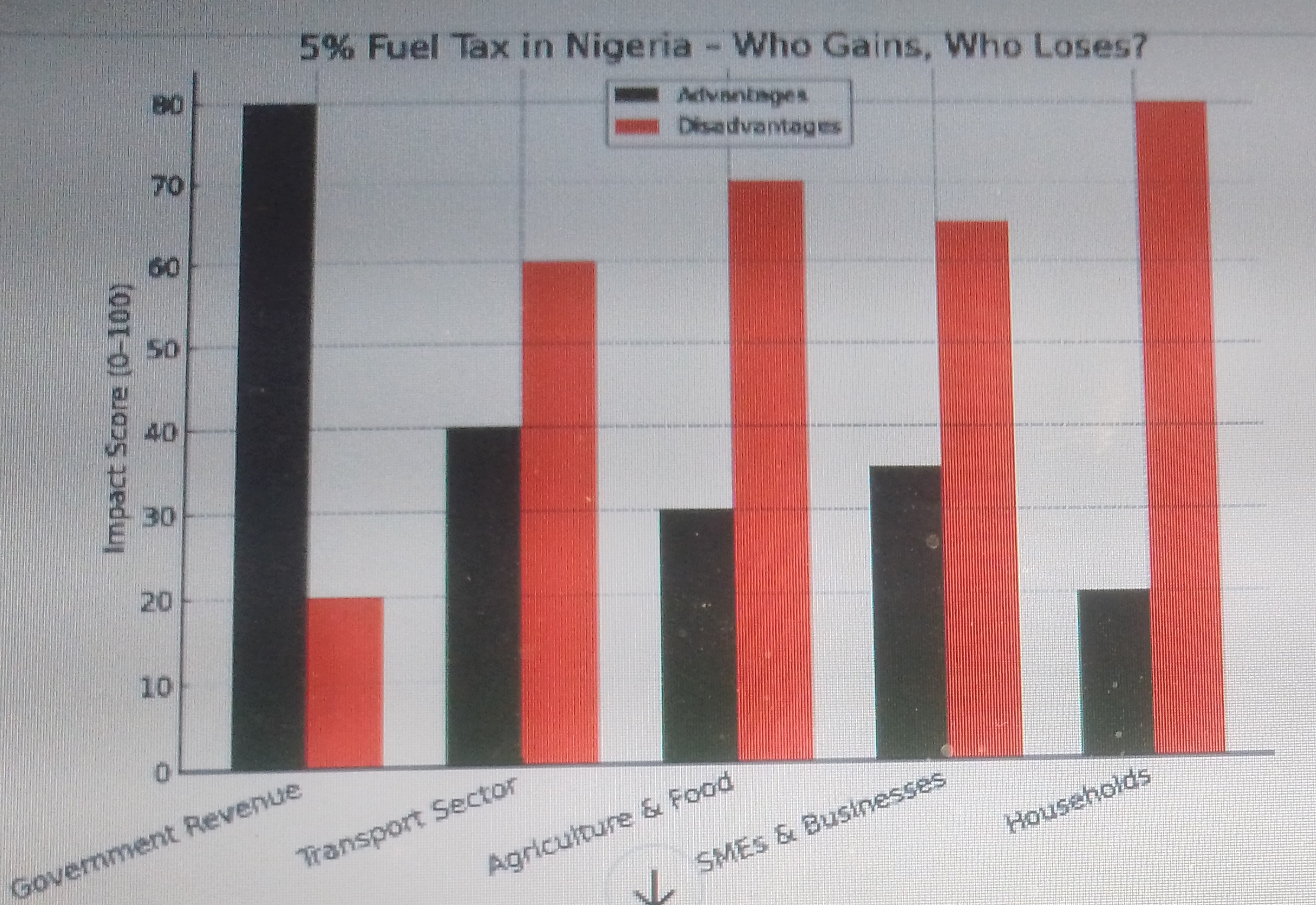
Infographic-style breakdown showing: Who gains, who loses, and what’s next for Nigeria under the new fuel tax.